
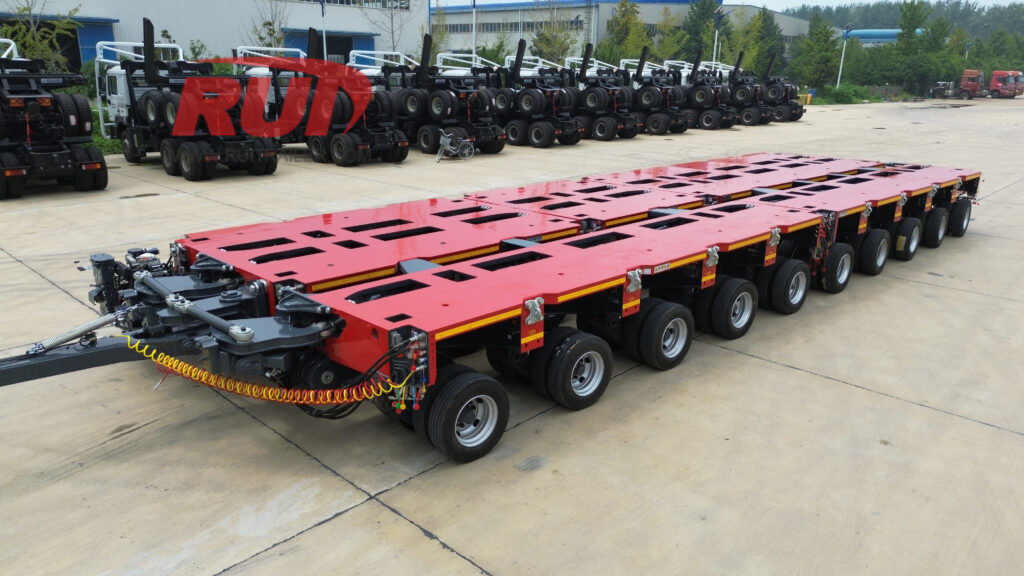
What Sets Modular Trailers Apart from Conventional Heavy-Duty Trailers
When you are facing a transport project that seems impossible due to extreme weight or volume, a standard trailer simply won\’t cut it. At RUITRAILER, we know that heavy haul logistics require more than just strength; they require adaptability. Unlike fixed-frame transporters, a modular trailer is a sophisticated system designed to evolve with your load.
Core Design: The Power of Infinite Scalability
The defining characteristic of our heavy-duty modular trailer systems is flexibility. We build these units based on a \”Lego-like\” principle. You are not limited to a fixed vehicle length or width. instead, you can couple individual modules—typically ranging from 2 to 6 axle lines—to create a transport platform perfectly sized for the job.
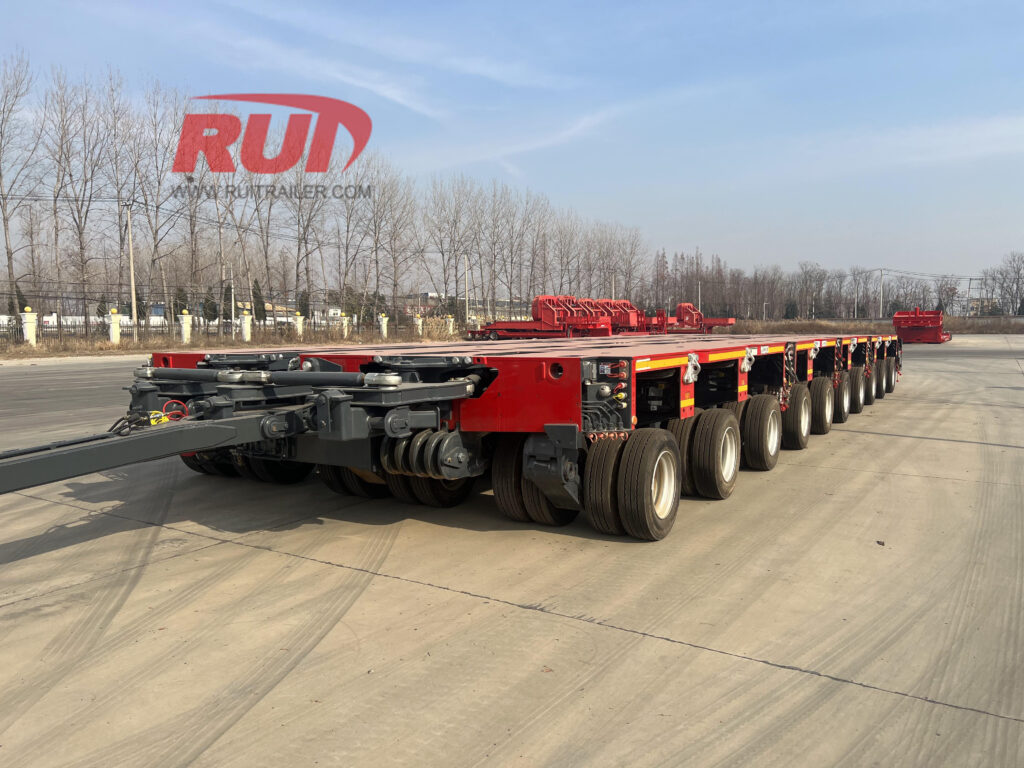
- Longitudinal & Lateral Coupling: We can connect modules end-to-end for long loads (like bridge sections) or side-by-side to widen the base for high centers of gravity.
- Hydraulic Suspension: Every axle line features hydraulic compensation. This ensures even pressure distribution across all wheels, protecting both the load and the road surface, even on uneven terrain.
- Combinable Platforms: Whether you need a lowbed, a flat deck, or a bolster configuration, the modular base remains the same, allowing for seamless integration.
Key Components of a Hydraulic Modular Trailer
To understand why these trailers perform so well under extreme stress, we need to look at the technology driving them.
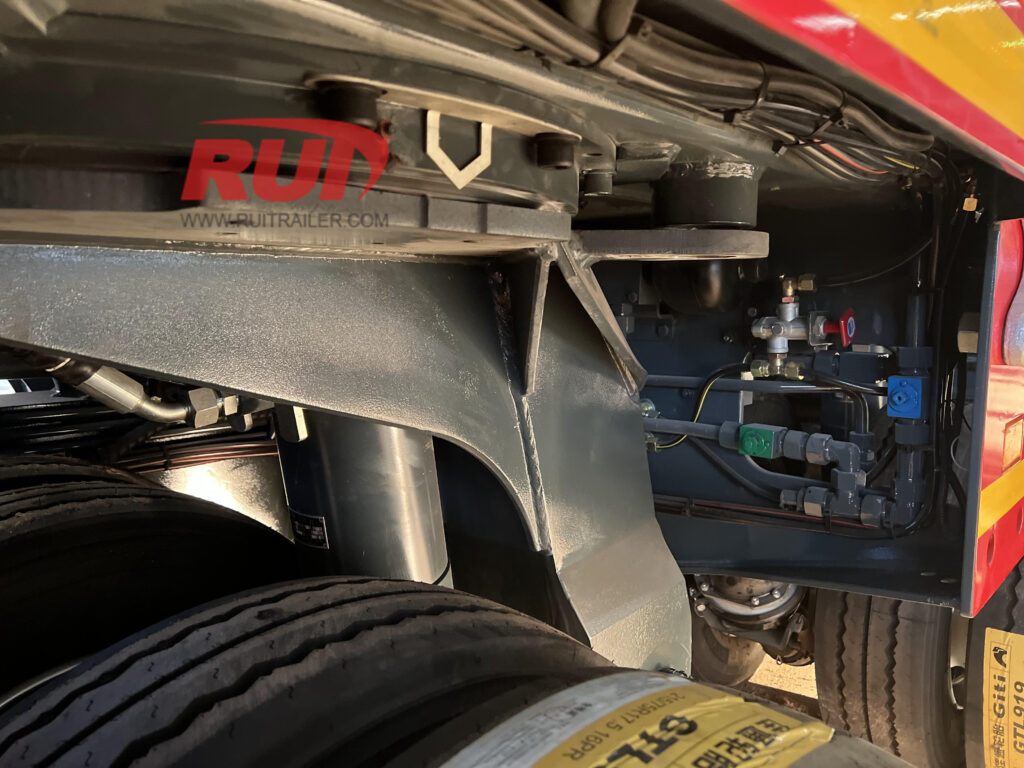
- Swing Axles & Steering: Our multi axle trailer designs utilize swing axles that offer steering angles capable of maneuvering tight corners with millimeter precision. This allows for complex steering programs essential for navigating confined industrial sites.
- Power Pack Unit (PPU): For self-propelled or drive-supported configurations, the PPU provides the hydraulic pressure required for steering, lifting, and driving the axles.
- Deck Options: From excavator decks to spacer decks for bridge girders, the modular design accepts various specialized attachments.
Comparison: Modular vs. Conventional Trailers
Why switch from a standard lowbed to a modular solution? It comes down to payload flexibility and load distribution. A conventional trailer has a fixed capacity; once you hit the limit, you are stuck. A modular system adapts to the weight by simply adding more axle lines.
| Feature | Conventional Lowbed/Flatbed | RUITRAILER Modular System |
|---|---|---|
| Payload Capacity | Fixed (Limited by chassis) | Unlimited (Scalable by adding modules) |
| Axle Load | Standard road limits | Up to 45 tons per axle line |
| Maneuverability | Limited by tractor radius | Precision Steering (All-wheel steer capability) |
| Terrain Handling | Mechanical/Air suspension | Hydraulic Compensation (600mm+ stroke) |
| Flexibility | Single-purpose design | Multi-purpose (Configurable for any load shape) |
By choosing a modular platform trailer, you are investing in a future-proof solution. Whether you are moving a 100-ton transformer today or a 5,000-ton ship section tomorrow, the system scales to meet the challenge.
Key Technical Specifications to Evaluate
When selecting a modular trailer, the technical data sheet is your road map to safety and efficiency. At RUITRAILER, we engineer our systems to meet rigorous global standards, ensuring compatibility with leading brands like Goldhofer and Scheuerle. Here are the critical specs you need to scrutinize.
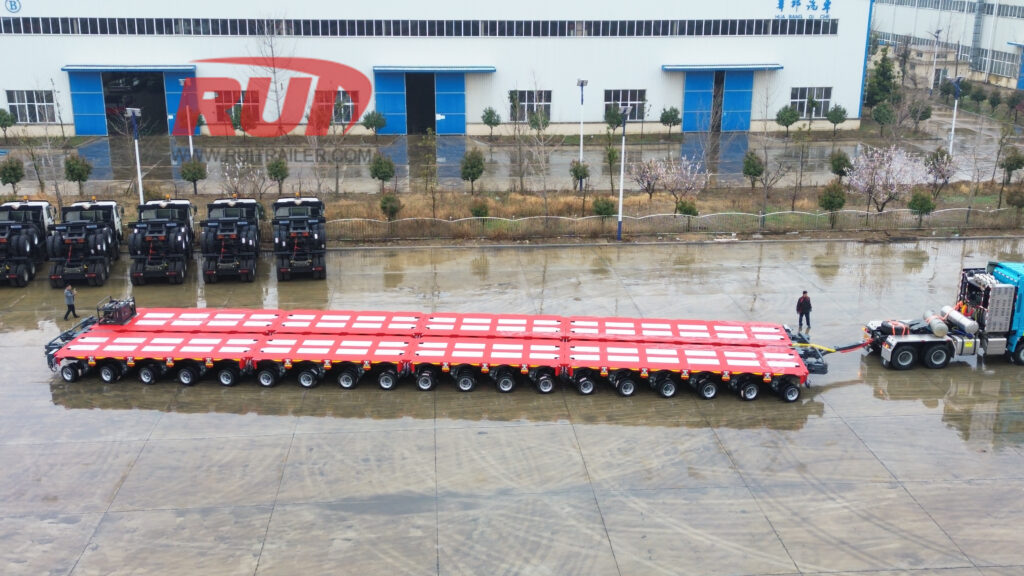
Axle Line Loads and Payload Capacity
The defining metric of any heavy-duty modular trailer is its capacity per axle line. For extreme loads, you need a system that supports high concentrated weights.
- Standard Payload: Our modules typically offer up to 45 tons per axle line.
- Total Capacity: By coupling multiple units longitudinally and laterally, we achieve total payloads ranging from 100 tons to well over 5,000 tons.
- Configuration: We offer 2, 3, 4, 5, and 6-axle line configurations to match specific project weights.
For a detailed breakdown of load charts and dimensions, you can review our full hydraulic modular trailer specs to see exactly how these numbers translate to real-world transport.
Stability: Suspension and Steering
Transporting high center-of-gravity loads requires exceptional stability. We utilize hydraulic axle compensation systems that allow for significant vertical travel (typically ±300mm to ±600mm). This ensures equal tire pressure distribution even on rough terrain, protecting both the load and the road surface.
- Steering Angles: Our steering systems offer angles up to 55° or 60°, enabling precise maneuvering in tight spaces.
- Low Deck Height: To clear bridges and tunnels, our designs maintain a low minimum ride height, often adjustable via the hydraulic suspension.
Structural Integrity and Drive Options
We construct our chassis using high-tensile steel (such as Q690) to guarantee high bending moment resistance. This is vital when bridging long distances with heavy, concentrated loads like transformers or bridge sections.
Flexibility is also built into the drive system. Our modular platform trailers can operate in three primary modes:
- Towed: Pulled by a prime mover (truck) for highway travel.
- Self-Propelled (SPMT): Integrated with a Power Pack Unit (PPU) and drive axles for onsite positioning.
- Assist Mode: Using drive axles to assist the truck on steep gradients.
Concise Specification Comparison
| Feature | Standard Configuration | Heavy-Duty Configuration |
|---|---|---|
| Axle Load | 36 Tons / Line | Up to 45 Tons / Line |
| Suspension | Hydraulic (+/- 300mm) | Hydraulic (+/- 600mm) |
| Steering Angle | 55° | Up to 60° |
| Tires | 215/75 R17.5 (Twin) | 215/75 R17.5 (Twin) |
| Compatibility | Goldhofer THP/SL | Scheuerle InterCombi / K25 |
Advantages of Choosing a True Modular Trailer System
When we tackle heavy transport projects, the modular trailer stands out as the ultimate problem solver for \”impossible\” loads. Unlike fixed-dimension trailers, these systems offer infinite scalability. We can couple modules longitudinally, laterally, or in open combinations (using bolsters) to create a platform that perfectly matches the specific dimensions and weight of the cargo. This flexibility allows us to transport everything from bridge segments to entire industrial plants without being limited by a static vehicle size.
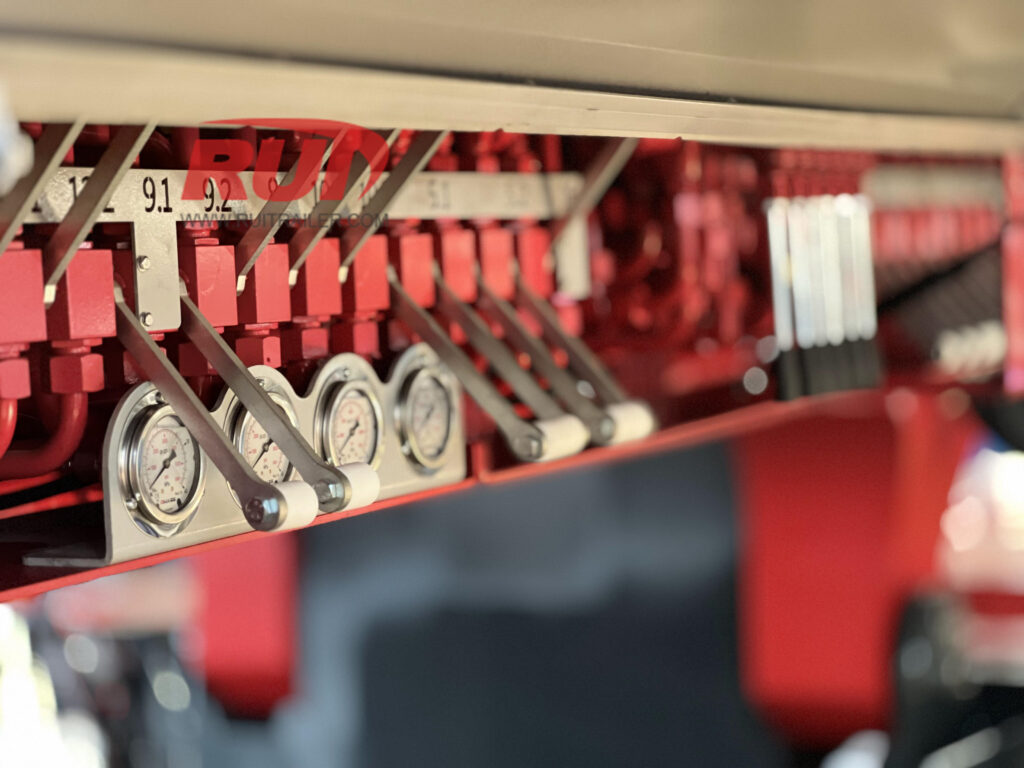
Key Benefits of Our Modular Solutions:
- Precision Maneuvering: Navigating confined spaces requires more than just brute strength. Our systems utilize advanced steering programs and hydraulic axle compensation to achieve millimeter precision, ensuring stability even on uneven terrain.
- Generational Interoperability: We design our equipment for the long haul. New modules are engineered to automatically integrate with existing fleets, allowing you to combine a modern hydraulic modular trailer with older units seamlessly.
- Economic Efficiency: We focus on reducing total cost of ownership. Compact dimensions allow models like the InterCombi to be shipped cost-effectively in flat rack containers. Additionally, specialized designs like the HighwayGiant feature unique folding mechanisms, enabling permit-free empty runs on return trips to save time and money.
- Superior Safety: The hydraulic connection of all axles guarantees even pressure distribution. This not only protects the road surface but also ensures maximum stability for concentrated loads or cargos with a high center of gravity.
Common Applications Across Industries
We design our modular trailers to handle transport tasks that standard equipment simply cannot touch. From moving entire industrial plants to navigating difficult terrain with top-heavy loads, the versatility of a heavy-duty modular trailer makes it the backbone of global heavy logistics.
Renewable Energy Logistics
The wind energy sector demands extreme precision. As turbines grow larger, transporting components becomes more complex. Our modules are frequently configured to transport long rotor blades and heavy nacelles. For the tallest onshore projects, specialized wind tower trailers are essential to manage the high center of gravity and extreme weight of steel or concrete tower sections while navigating tight corners on access roads.
Infrastructure and Construction
Modern infrastructure projects rely on precast elements that are too heavy for conventional transport.
- Bridge Construction: Moving massive steel beams and concrete girders requires high bending moment capacity. A girder bridge trailer configuration allows for the safe transport of these concentrated loads by distributing weight effectively across multiple axle lines.
- Tunneling: We see frequent use of multi-axle trailers for moving tunnel boring machine (TBM) shields and heavy tunnel segments.
Power Generation and Heavy Industry
In the power sector, failure is not an option. Modular platform trailers are the standard for relocating transformers, gas turbines, and generators. These loads often exceed 100 tons and require the hydraulic axle compensation of our systems to ensure stability on uneven ground. Similarly, in the oil, gas, and chemical industries, we facilitate the movement of pressure vessels and complete plant modules.
Marine and Shipyard Operations
Shipyards utilize self-propelled and towed modular combinations to move ship sections and entire vessels. The electronic steering systems and high axle loads allow operators to position ship blocks with millimeter precision for final assembly.
Emerging Heavy Logistics
Beyond traditional sectors, we are seeing increased demand in defense logistics and heavy machinery relocation. Whether it is moving mining excavators or specialized military hardware, the ability to couple modules longitudinally and laterally ensures we can build a transport platform that fits the exact footprint of the cargo.
How to Select the Right Modular Trailer for Your Project
Choosing the correct modular trailer configuration is critical for ensuring safety, legal compliance, and cost-efficiency in heavy haulage. It is not just about total capacity; you must evaluate the specific axle line load capacity against the infrastructure capabilities of your transport route. We recommend a step-by-step evaluation process that starts with analyzing the payload\’s center of gravity and dimensions, followed by a detailed route survey to identify bridge restrictions and tight corners.
Critical Evaluation Factors
When specifying your equipment, consider these regional and technical constraints:
- Regional Compliance: Markets like North America often require dual-lane designs or expandable systems to meet bridge formulas, whereas European operations typically prioritize compact dimensions for tight roundabouts.
- Interoperability: Ask manufacturers if their new modules can mechanically and hydraulically couple with your existing fleet. Compatibility with systems like the InterCombi modular system or Goldhofer units can save significant capital investment.
- Support & Longevity: Verify warranty terms and the speed of spare parts delivery. A cheap trailer becomes expensive if it sits idle waiting for a valve.
Customization with RUITRAILER
At RUITRAILER, we understand that standard solutions do not fit every \”impossible\” load. We offer extensive customization, from specialized deck inserts to hydraulic modular trailer accessories that adapt to unique cargo shapes. Whether you need a high bending moment trailer for concentrated loads or a specific side-by-side hydraulic modular trailer configuration for extra stability, we engineer the solution to match your exact project requirements.
Top Manufacturers and Market Leaders in 2026
The global heavy transport landscape is defined by precision engineering and reliability. When evaluating a heavy haul trailer manufacturer, you will inevitably encounter the industry giants that have set the benchmarks for decades. Brands like Goldhofer, Faymonville, Scheuerle (TII Group), Nicolas, and Cometto are synonymous with high-quality hydraulic modular trailer systems.
Scheuerle, for example, is widely recognized for its InterCombi and K25 series, which offer exceptional axle loads and maneuverability for transporting industrial plants and wind energy components. Goldhofer remains a dominant force with its THP series, known for robust construction, while Faymonville and Cometto continue to innovate in both towed and self-propelled sectors. These manufacturers have established the technical standards for axle line load capacity and hydraulic stability that the rest of the market follows.
The RUITRAILER Advantage
While the established European brands offer premium technology, the market increasingly demands flexibility, speed, and cost-efficiency. As a dedicated modular trailer Manufacturer and Supplier, RUITRAILER has positioned itself as a strategic partner for operators who need high-performance equipment without the excessive lead times or capital expenditure associated with legacy brands.
Here is how RUITRAILER differentiates itself in the 2026 market:
- Seamless Fleet Integration: We understand that you likely already own equipment. Our heavy-duty modular trailer units are engineered for full interoperability, often being Goldhofer modular trailer compatible. This allows you to couple our modules laterally or longitudinally with your existing fleet, preserving your initial investment.
- Rapid Delivery Timelines: In the project logistics world, waiting six to twelve months for a trailer can mean losing a contract. We prioritize streamlined manufacturing processes to ensure your multi axle trailer is delivered and operational when your project starts.
- Cost-Effective Engineering: We provide the same high-tensile steel construction and hydraulic precision as top-tier brands but at a price point that improves your operational margins.
- Global After-Sales Support: We do not just sell steel; we support your operations. From spare parts availability to technical training on hydraulic suspension maintenance, our responsive support network ensures your fleet minimizes downtime.
By combining innovative engineering tailored to diverse global markets with a customer-centric approach, RUITRAILER offers a smart alternative for heavy haulage companies looking to scale their capabilities efficiently.
Maintenance and Safety for Modular Trailers
To get the most out of your heavy-duty modules, rigorous maintenance of the hydraulic suspension and steering systems is non-negotiable. These components deliver the \”millimeter precision\” and ground protection required for transporting heavy loads. Regular inspections ensure that the hydraulic axle compensation functions correctly, maintaining stability on uneven terrain and preventing damage to both the road and the cargo.
Ensuring Long-Term Reliability
Safety starts with understanding your equipment\’s limits. We emphasize the importance of verifying axle line load capacity and high bending moments before every transport. Utilizing professional service support for load case calculations can prevent structural overloads and ensure tipping stability during critical moves.
Key Ownership Considerations:
- Spare Parts Availability: Quick access to genuine parts minimizes downtime. Efficient logistics are crucial for keeping your fleet operational.
- Structural Integrity: Regular checks on the chassis and coupling elements are essential, especially after handling concentrated loads with high centers of gravity.
- Operational Training: Proper operation is just as important as the hardware. Ensuring your team understands the steering programs and coupling mechanisms guarantees safe execution.
Investing in a modular platform trailer is a long-term commitment. By prioritizing certified safety standards and proactive maintenance, you protect both your investment and the valuable cargo you transport.
Future Trends in Modular Trailer Technology
The heavy transport industry is evolving rapidly, driven by the need for greater efficiency and stricter environmental standards. As a forward-thinking manufacturer, we see the modular trailer landscape shifting toward smarter, cleaner, and more capable systems. Innovation is at the core of keeping fleets future-proof, ensuring that the equipment supplied today remains relevant for the complex challenges of tomorrow.
Sustainable Power and Hybrid Systems
One of the most significant shifts is the move toward sustainability in heavy-duty modules. We are witnessing an increased adoption of electric and hybrid Power Pack Units (PPU). These units are designed to reduce emissions and noise, making them essential for operations in urban environments or strictly regulated project sites. This evolution allows operators to maintain the high power output required for hydraulic functions while significantly minimizing their carbon footprint.
Digitalization and Smart Operation
The integration of advanced technology is transforming how we manage heavy transport logistics.
- Advanced Telematics: Remote monitoring integration allows fleet managers to track real-time data on axle loads, hydraulic pressures, and system health, preventing downtime before it happens.
- Smarter Steering Automation: Enhancements in electronic steering programs enable even greater precision, allowing for \”millimeter accuracy\” in positioning massive loads without extensive manual intervention.
- Higher Payload Efficiency: Continuous engineering improvements are pushing the limits of high-tensile steel, resulting in modules that offer higher payload capacities relative to their dead weight.
Staying ahead of these trends ensures that your fleet is ready for the next generation of industrial challenges. You can reach out to our engineering team to discuss how to integrate these advanced technologies into your current transport operations.
Frequently Asked Questions About Modular Trailers
What is the difference between a modular trailer and an SPMT?
The main difference lies in the drive system. A standard modular trailer (or modular platform trailer) is a non-driven unit that requires a prime mover (truck) to pull or push it via a drawbar or gooseneck. In contrast, a Self-Propelled Modular Transporter (SPMT) is equipped with its own Power Pack Unit (PPU) and hydraulic drive axles. This allows the SPMT to move independently and rotate 360 degrees without a truck, making it ideal for extremely heavy loads in confined spaces like shipyards or chemical plants.
How do I calculate the axle load for a specific project?
Calculating axle load involves more than just dividing the total weight by the number of axles. You must calculate the combined weight of the payload and the trailer\’s dead weight, then distribute it based on the load\’s Center of Gravity (CoG). If the CoG is off-center, certain axle lines will bear more pressure than others. To ensure safety and prevent overloading, we strongly suggest you contact our technical team to assist with precise load case simulations and grid calculations.
Are RUITRAILER modules compatible with Goldhofer systems?
Yes, we understand the importance of fleet flexibility. Our hydraulic modular trailer units are engineered for seamless interoperability with Goldhofer modular trailer systems (specifically the THP/SL series). You can mechanically couple our modules with your existing Goldhofer units both longitudinally and laterally. This allows you to expand your fleet\’s capacity and versatility without facing compatibility issues during operation.
What maintenance is required for hydraulic suspension systems?
The hydraulic suspension ensures stability and equal load distribution, so keeping it clean is vital. Routine maintenance should focus on:
- Fluid Quality: Regularly check hydraulic oil levels and replace filters to prevent contamination, which can damage valves.
- Leak Inspection: Visually inspect all hoses, couplings, and cylinders for leaks before every heavy haul transport.
- Accumulators: Check nitrogen pressure in the accumulators to ensure proper suspension dampening.
- Lubrication: Grease all pivot points and steering rods to minimize wear on the multi axle trailer components.
 English
  German
  Turkish
  French
  Portuguese
  Russian
  Arabic